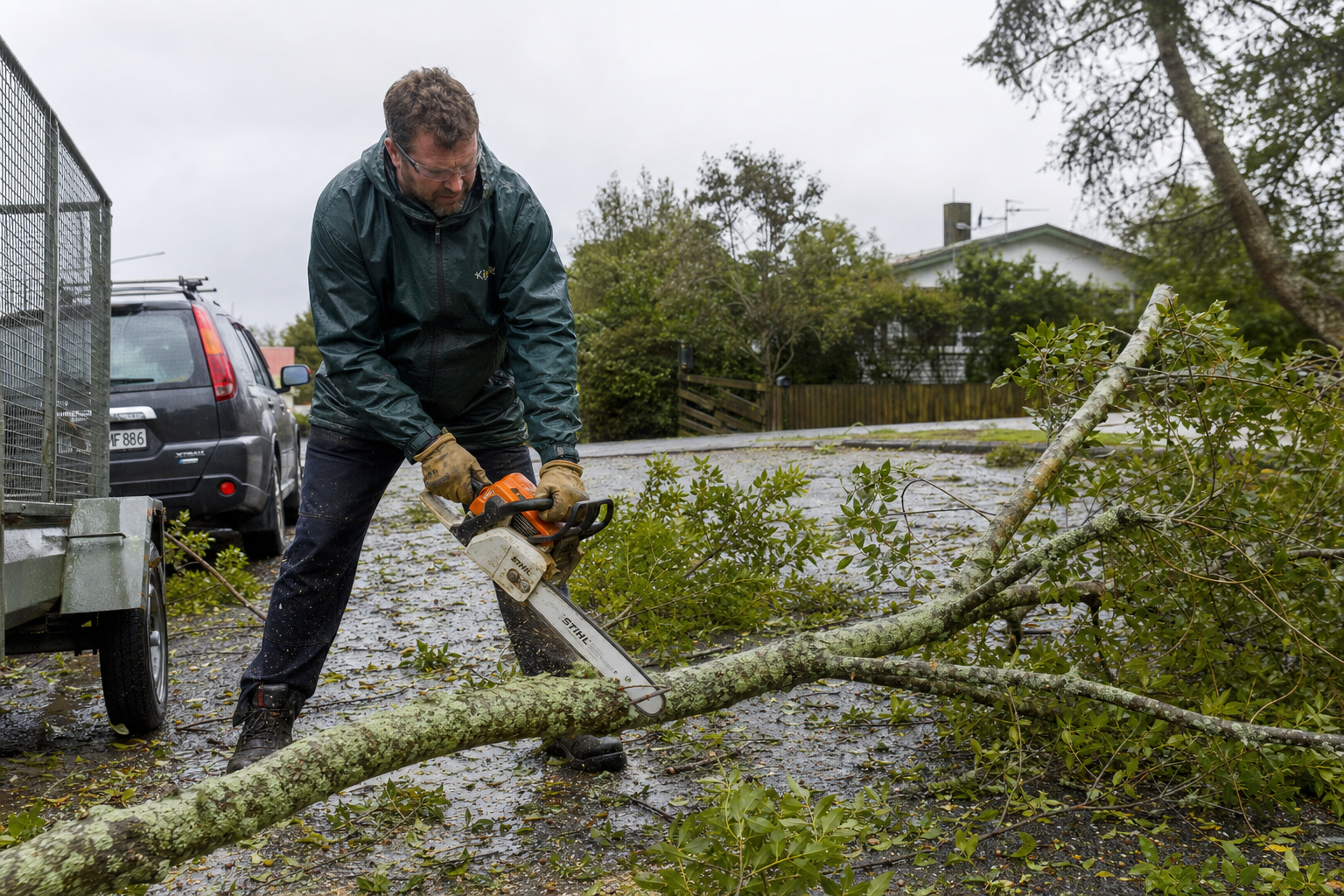
Post-storm response — how the roster works
Whenever MetService names an ex-tropical cyclone or issues a strong-wind warning above 100 km/h for the Waikato, we put the regular fortnightly round on hold for 36 hours and switch the phone over to a storm roster. Existing fortnightly clients get a heads-up text the night of; new callers ring (07) 853 4267 and we triage on the phone.
Triage priority on the morning after a major event:
- Trees blocking driveways, paths or doors — first
- Trees touching the house (especially with branches across guttering) — second
- Trees down across the section but not blocking access — third
- Heavy windfall, light branch, leaf-mat blocking drains — fourth
- Cosmetic tidy and deck wash — last (the day after, usually)
For anything in the first two categories that needs a real chainsaw we go straight to Ben Carrington's arborist crew in Te Rapa and project-manage from our end. We don't fell anything over five metres ourselves.
Typical cleanup jobs after a Waikato storm
We get the same five or six job types after most named weather events. Below is roughly what a standard post-storm callout covers:
- Downed branch removal — hand-saw or small chainsaw on the ground only, branches stacked at the kerb or onto the trailer
- Drain unblock at the kerb — clear the leaf-mat off the storm drain so the next downpour drains properly
- Deck wash — a windy week leaves the deck with a fine grit of pollen, twigs and soil splash. Quick wash with the petrol washer and a scrub on the steps.
- Gutter spot-clean — single-storey houses only, ground-level ladder, hand-scoop the heavy leaf-and-twig debris
- Re-stake young trees that have pushed over — common after a westerly
- Greenhouse / shadehouse tidy — broken panels noted for your insurance, not replaced by us
Autumn-leaf clearance — the May–June window
Most Waikato sections get a heavy leaf-drop through May and into early June — liquidambar, oak, plane tree, and the neighbour's deciduous magnolia. We run a one-off "autumn tidy" slot from the last week of April through to mid-June, mostly aimed at sections that don't take a fortnightly round.
A standard autumn tidy is one and a half to two hours: rake, blow paths and the kerb, clear leaf-mat from drains, top-mulch beds with the leaf debris where it'll compost down by spring, and bag the rest for green-waste collection. Most clients book one autumn visit and that's that until the storm cleanup roster opens in November / December.
Gutter spot-clean — ground level only
Single-storey houses we'll do — ground-level ladder, hand-scoop the leaf-and-twig debris into a bucket, flush the downpipe at the end. Two-storey houses or anything that needs a roof ladder we don't go on. We can refer to a Hamilton gutter operator who carries the harness kit.
Our flat rate covers the front, back and one side of a standard single-storey. Properties with a complex roofline or guttering that hasn't been touched in three years are quoted by the site visit.
What it costs
Flat pricing for standard callouts. All prices include 15% GST.
- Post-storm callout (within 48 hr of a named event), one to two hours: from $135
- Downed branch removal, standard suburban section: $165 flat
- Autumn-leaf clearance (one-off), standard town section: $135 flat
- Gutter spot-clean, single-storey house only: $95 flat
- Deck wash with petrol washer: $110 flat
- Green-waste haul-off (if needed): $25 per trailer load
- After-hours or Sunday emergency callouts: quoted on the phone, typically $185–$285
What we don't do
Short list, said clearly:
- Tree felling over five metres — referred to Carrington Tree Services in Te Rapa
- Roof work above ground-floor — not insured, not equipped
- Insurance assessments — we won't write a report for your claim; insurers want a registered assessor for that
- Chainsaw work above shoulder height — even on a small tree, ground-only or referred
- Anything within ten metres of a downed power line — call your lines company first
Related services
- Section maintenance — fortnightly upkeep so the next storm is less work
- Hedge & tree work — proactive trim and small tree removal
- Native planting — re-staking and replanting after wind damage