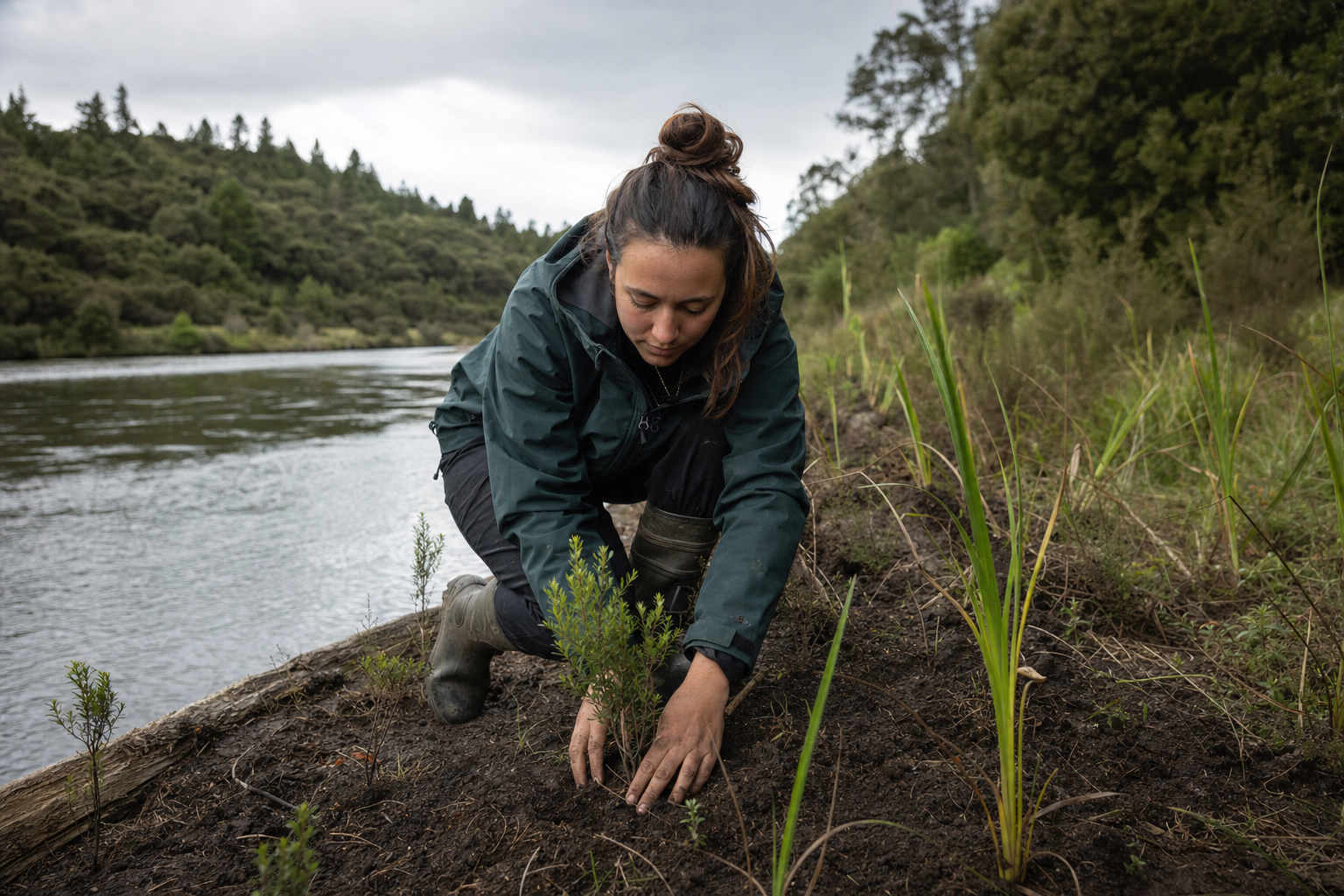
Riparian planting — along the Waikato river edge
About a third of our planting work is riparian — the strip along a creek, drain or river edge that protects the bank, filters runoff and gives the kingfishers and tūī somewhere to actually live. The Waikato Regional Council backs most of this work on the rural fringe, and we can pencil out a planting plan that fits a council subsidy where one's available (Hamilton City, Waikato District and Waipā District all run slightly different schemes — Hemi knows the current state on each).
A standard riparian strip on a lifestyle block — say a 60 m run along a back-boundary creek in Tauwhare or Matangi — is roughly:
- Ground prep — knock back the kikuyu / pasture grass with a spot herbicide on a calm autumn morning
- Carex secta / Carex virgata along the wettest edge — clump-forming sedges that hold bank against winter flow
- Harakeke (Phormium tenax) set back from the water — splits the flow and gives the tūī a winter feed
- Kānuka behind that — fast-growing pioneer, sets the structure for the next decade
- Manuka and pittosporum mixed through the middle for diversity
- Mulch every plant with bark or untreated wood chip
- Stake the kānuka and pittosporum at planting, remove the stake after eighteen months
Plant selection — Waikato clay, Waikato wind
We plant what actually performs on the heavy yellow-grey clay most Waikato sections sit on. Below is roughly the working list — we cross-reference Naturally Native's grower notes against what we've watched come through over a decade of plantings:
- Kānuka (Kunzea ericoides) — fast pioneer, gets you height in three years, then the slower species fill in underneath. Better on dry ridges than manuka.
- Manuka (Leptospermum scoparium) — slower than kānuka but flowers earlier; pick the local-source strain (we use Naturally Native's Waikato seed-grown stock)
- Harakeke / NZ flax (Phormium tenax) — bombproof on clay, splits the wind, feeds the tūī from June. Don't plant within 2 m of a path (the leaves overhang).
- Cabbage tree (Cordyline australis) — only as occasional accents — they look great solo, ratty in mass plantings
- Pittosporum tenuifolium — fills the middle layer, holds shape, makes a decent windbreak
- Coprosma robusta / Coprosma repens — under-storey, takes shade, holds berries for the bellbirds
- Kahikatea (Dacrycarpus dacrydioides) — for damp ground only, fifty-year plant, plant five and watch them race the kānuka in twenty years' time
- Carex secta / virgata — bankside sedges, the workhorse of riparian planting
We don't plant invasive ornamentals (no agapanthus, no Mexican feather grass), and we'd rather talk you out of a hebe hedge along the boundary if you've got the room for a proper native mix instead.
When to plant — May through August
The planting window in the Waikato is winter — May through August — when the soil is wet, the temperature is steady, and the new roots can establish before the first hot week of November. Late autumn (April) plantings struggle if the ground hasn't softened yet; spring plantings (September onwards) need watering through summer and have a noticeably higher death rate.
We book planting days from mid-April for May–August slots. A typical project is one or two planting days (we get through 300–500 plants per day depending on ground prep), then a follow-up visit at six and twelve weeks, then a watering schedule through the first summer.
Follow-up & watering — the bit that makes it take
Most planting projects fail in their first summer, not their first winter. We include four follow-up visits in the project quote — at six weeks, twelve weeks, six months, and twelve months — covering:
- Re-mulch any plants where the bark has thinned
- Re-stake anything that's pushed over in a westerly
- Hand-weed around the base of each plant — kikuyu will out-compete a young harakeke in one summer
- Replace plants that haven't taken (we cover replacement at no extra labour cost on anything under twelve months)
- Water through dry stretches — usually January and February, two visits each
What it costs
Native-planting projects are quoted per project. Below is the rough breakdown so you have a number in your head before you ring.
- Site visit and planting plan (1–2 hours): $185 — credited against the project quote if you book
- Plants — at supplier receipt + 10% (covers our trip to Naturally Native or Wairere)
- Planting labour — by the day, three of us: $1,680 per day (gets through 300–500 plants)
- Mulch (bark or untreated chip): supplier receipt + 10%, usually $180–280 per cubic metre delivered
- Follow-up watering visits (summer): $85 per visit on a fortnightly slot
A small native-planting project (front garden, say 40 plants of mixed harakeke / coprosma / hebe) typically runs $1,200–$1,800 all-in. A 60 m riparian strip on a lifestyle block — say 350 plants, mulch, stakes, follow-ups — is more like $4,200–$5,500.
Where we source — and where we don't
We don't run a nursery. Plant orders go to two suppliers we trust:
- Naturally Native (Tauranga) — bulk orders of the workhorse species. Local-source seed stock for manuka and kānuka, which matters for the long-term genetics of a planting.
- Wairere Nursery (Gordonton) — specialist orders, larger grades, anything where you want a 1.5 m specimen rather than a tube-stock plug
Smaller orders we'll pick up from the Mitre 10 Trade Hub in Te Rapa, or the Awapuni Nursery weekend stall when it suits. We don't use mass-market garden-centre stock for project plantings — the survival rate is too variable.
Related services
- Section maintenance — fortnightly upkeep once the planting is in
- Hedge & tree work — annual trim of the planted hedge run
- Storm cleanup — re-staking after a wind event